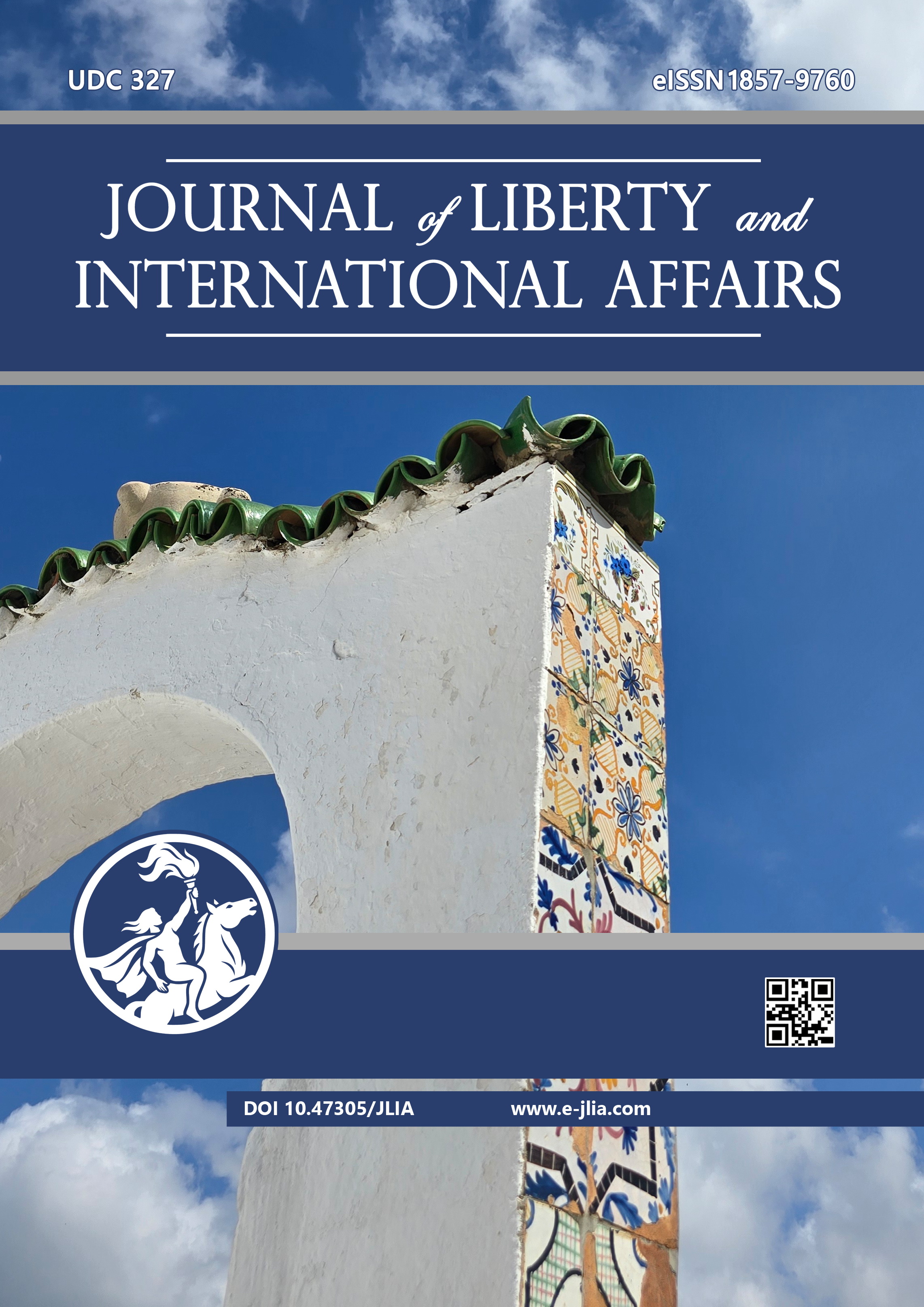
The Journal of Liberty and International Affairs (JLIA) is a triannual (three regular issues per year), international, open-access, peer-reviewed academic journal published by the Institute for Research and European Studies. The journal follows a regular publication schedule, with occasional special issues dedicated to emerging themes of particular academic relevance.

JLIA publishes original research articles, review articles, and book reviews that contribute to contemporary scholarly debates across its fields of interest. The journal serves as a platform for critical and interdisciplinary examination of liberty and international affairs, exploring their separate dimensions as well as their complex interconnections within global political, legal, economic, and social contexts.

The journal welcomes diverse, innovative, and theoretically informed contributions from disciplines including law, political science, security studies, economics, and international relations. JLIA particularly encourages research that advances critical perspectives, challenges established assumptions, and provides forward-looking insights into pressing global issues.


Journal of Liberty and International Affairs | JLIA

First publication: April 2015

ISSN (online): 1857-9760 | Open Access | Language: English | Indexing/Abstracting

JLIA uses the plagiarism screening tool: Grammarly

Contact: contact@e-jlia.com

Publication types: Research articles, Review articles, Book reviews, Editorials, Correspondences, Corrigenda

Backlist volumes are available from here

Journal of Liberty and International Affairs is indexed in Scopus (Elsevier), among other international indexing databases.


Indexed: Scopus, ANVUR (Class A journal) | EBSCO | International Political Science Abstracts (IPSA) (selected political science content) | Directory of Open Access Journals (DOAJ) | Social Science Open Access Repository (SSOAR) | Central and Eastern European Online Library (CEEOL) | Columbia International Affairs Online (CIAO) | European Reference Index for the Humanities and the Social Sciences (ERIH PLUS) | HeinOnline | ProQuest (Social Science Premium Collection) | ProQuest (Political Science Database) | ProQuest (Social Science Database) | ProQuest (Worldwide Political Science Database) | ProQuest (International Bibliography of the Social Sciences - IBSS) | Crossref | LexisNexis | Google Scholar, etc.

Click here to explore more indexing and abstracting databases.


Call for Papers (Deadlines)

The Journal of Liberty and International Affairs welcomes submissions throughout the year. For authors who prefer to plan ahead, the journal operates on three submission cycles:

- First Submission Cycle: January 1 – April 30

- Second Submission Cycle: May 1 – August 31

- Third Submission Cycle: September 1 – December 31

Manuscripts submitted within each cycle will be considered for the corresponding issue of the journal. Early submissions are strongly encouraged.

Articles should represent a substantial advance in the particular field within the scope of the journal in terms of originality (empirical or theoretical), importance to researchers in the field, and interest for readers and researchers outside the field. The journal categorizes its published articles as either research articles or review articles. This is a fully open-access journal, meaning all articles are freely available and ensure maximum worldwide dissemination in exchange for an article publication fee. Authors should review the Journal Policies, About the Journal, Review Policy, Article Guidelines, and Publication Ethics sections before preparing their manuscript, and ensure it complies with these guidelines before submission.

You can register and submit online or email submissions to contact@e-jlia.com

We prefer that you submit your article through the journal's online submission system.

Please register and log on to JLIA. Two roles are available in the registration process: "Author" and "Reviewer". If you want to submit an article, you need the role "Author". Registration and submission are free of charge.

We are pleased to announce that Dr. Gustavo Diaz Matey has joined the International Editorial Committee of the Journal of Liberty and International Affairs

2026-10-17

Dr. Gustavo Diaz Matey has officially joined the International Editorial Committee of the Journal of Liberty and International Affairs.

Dr. Diaz Matey is a Senior Lecturer in the Department of International Relations at the Faculty of Political Science, Universidad Complutense de Madrid (UCM). He holds a PhD in Political Science from UCM and an MA in Intelligence and Security Studies from the University of Salford, Manchester. He currently serves as Co-Director of the Complutense Group for International and Strategic Studies and President of the Spanish Association for International and Strategic Studies.

With extensive academic and practical experience—including nearly a decade as an Intelligence Manager at ICEX Spain Export and Investments—his expertise bridges theoretical intelligence, cognitive competition, and international security. He is a longtime member of the Editorial Board of the International Journal of Intelligence and Counterintelligence and has authored influential monographs, including Inteligencia teorica, Servicios de inteligencia en el siglo XXI, and most recently, Disinformation and Counternarratives in International Security: Cognitive Competition (Routledge).

His track record spans leadership in EU-funded research, such as the CITEX project, and contributions to leading institutions including the Elcano Royal Institute, CIDOB, and UNISCI.

We warmly welcome Dr. Diaz Matey to our editorial team and look forward to his contributions to upholding the rigorous scholarly standards of the journal.

JLIA Team

CALL FOR PAPERS | SPECIAL ISSUE 2027: Western Balkan Geopolitics in Transition: Power, Security, and Integration

2026-09-21

Western Balkan Geopolitics in Transition: Power, Security, and Integration
Journal of Liberty and International Affairs (JLIA)
ISSN: 1857-9760 | Scopus-indexed | Open Access
Guest Editor: Nenad Stekic, Assistant Professor, University of Belgrade – Faculty of Security Studies

Overview
The Western Balkans are entering a period in which the assumptions that have anchored the region’s foreign and security policy for a generation can no longer be taken for granted. The credibility of transatlantic security guarantees, the leverage of EU conditionality, and the predictability of great-power engagement are all in flux, against the backdrop of the war in Ukraine, intensifying geoeconomic competition, and a second Trump administration whose mandate ends in January 2029. Governments in the region therefore face a strategic inflection point: whether to lock in current alignments or to hedge against a markedly different international order.

This Special Issue invites rigorous, theoretically informed, and empirically grounded research on that transition. It combines assessments of the 2025–2028 period with forward-looking, scenario-based analysis, seeking to move beyond retrospective accounts of great-power competition towards a forecasting-oriented research agenda on the region’s foreign policy futures. The Western Balkans are understood here as the ex-Yugoslav non-integrated EU space plus Albania.

Guiding Questions
• How are Western Balkan states, individually and comparatively, recalibrating their foreign policy preferences and hedging strategies in anticipation of a post-Trump transition, and what does this reveal about the drivers of small-state alignment under systemic uncertainty?
• Will the preferences of the powers most active in the region—the European Union, the United States, China, and Russia—continue, reverse, or reset once the current US administration concludes, and what would each scenario mean for the region’s security architecture, EU accession trajectory, and connectivity relationships?

Thematic Strands
Contributions should fall within one or more of the following strands, each read through the lens of continuity and change. Country coverage is intended to be balanced across the region, and comparative designs are particularly welcome:

1. Western Balkan foreign policy responses and hedging
• Foreign policy preferences, alignment choices, and hedging or multi-vector strategies of individual states
• Domestic drivers of alignment: regime type, elite preferences, public opinion, and party politics
• Small-state behaviour and alliance formation under systemic uncertainty

2. Great-power preferences in transition
• Persistence, shift, or reversal in US, EU, Chinese, and Russian priorities towards the region
• Scenario frameworks, forecasting models, and other tools for anticipating post-2028 configurations
• China’s regional footprint—connectivity, infrastructure, investment, and security cooperation—in comparative perspective

3. European integration under uncertainty
• Credibility of the accession process and of EU conditionality
• The Growth Plan for the Western Balkans and other instruments of staged or differentiated integration
• Enlargement in a reconfigured transatlantic and geopolitical context; democratic resilience and backsliding

4. Security and hybrid threats
• Disinformation, foreign information manipulation, and external influence in media and electoral environments
• Organised crime, energy security, and critical infrastructure
• Spillover from the Russia–Ukraine war and broader systemic realignment, assessed for durability beyond 2028

Types of Contribution and Approaches
We welcome original research articles and review articles that combine theoretical rigour (for example, regime-type, alliance-formation, hedging, and small-state frameworks) with original empirical material. Quantitative, qualitative, and mixed-methods designs are all encouraged, including comparative case studies, process tracing, media-sentiment and risk-assessment methodologies, event and survey data, and explicitly scenario-based or forecasting approaches. Purely descriptive or policy-advocacy pieces without a clear analytical contribution will not be considered.

Submission Process
• Abstracts: Send an abstract of 300–500 words, five keywords, and a short biographical note (name, affiliation, ORCID iD) to the Guest Editor at nenad.stekic@fb.bg.ac.rs by November 25, 2026. Abstracts should clearly state the research problem, theoretical approach, methodology, principal argument, and expected contribution.
• Invitation and Full Papers: Authors of accepted abstracts will be invited to submit full manuscripts of 6,000–8,000 words, including references, through the JLIA online submission system, selecting this Special Issue.
• Peer Review: All manuscripts undergo editorial screening followed by double-blind peer review. Submissions must follow the JLIA Author Guidelines, Review Policy, and Publication Ethics statements.

Publication Fees & Discounts
Upon formal acceptance, authors are required to pay a publication fee of 500 EUR (or USD equivalent).
• Low-Income Economies (LIEs): 60% discount (Read policy).
• Top 2% Scientists: Full 100% waiver if the corresponding author is listed in the Stanford/Elsevier global top 2% citation ranking.
• EU-Funded Projects: 20% discount for research originating from EU-funded programmes (Horizon Europe, COST Actions, Erasmus+, etc.).

Indicative Timeline
• Circulation of the Call: October / November 2026
• Abstract Submission Deadline (300–500 words): November 25, 2026
• Notification of Abstract Outcome & Invitation to Submit: December 15, 2026
• Full Manuscript Submission Deadline: March 15, 2027
• Double-Blind Peer-Review Period: March – May 2027
• Revised Manuscript Submission: June 2027
• Final Editorial Decisions: August 2027
• Publication of the Special Issue: Autumn 2027

Guest Editor
Nenad Stekic is an Assistant Professor at the University of Belgrade – Faculty of Security Studies. His research focuses on China’s security and foreign policy, Sino-Serbian and Sino-European relations, the Belt and Road Initiative in the Western Balkans, military interventions, and political regimes. He is the author of the monograph A Hesitant Hegemon: Layers of China’s Contemporary Security Policy (2023), Editor-in-Chief (2024–2026) of The Review of International Affairs, and External Country Expert for Serbia, Bosnia and Herzegovina, and Montenegro for the Varieties of Democracy (V-Dem) Institute.

About the Journal
The Journal of Liberty and International Affairs is a triannual, international, open-access, peer-reviewed journal published by the Institute for Research and European Studies (IRES). It welcomes contributions from political science, international relations, security studies, law, and economics, and is indexed in Scopus, among other databases.

Contact: Nenad Stekic (Guest Editor) – nenad.stekic@fb.bg.ac.rs

Official ANVUR Classification Extension for Area 14/C2 (Retroactive to 2015)

2026-09-04

We are pleased to inform our authors, reviewers, and readers that the Italian National Agency for the Evaluation of Universities and Research Institutes (ANVUR) has officially extended the scientific recognition of the Journal of Liberty and International Affairs (ISSN: 1857-9769).

Pursuant to Resolution no. 172/2025 (Delibera 172/2025), the Board of Directors has approved the extension of the journal’s scientific classification:

  • Scientific Sector: Area 14/C2
  • Effective Coverage: Retroactive to all years of publication, beginning with our inaugural volume in 2015
  • Status Update: The updated designation will appear in the forthcoming official publication of the journal lists (Elenchi delle riviste scientifiche)

This decision formally validates all past and present contributions published in the journal for institutional research assessments, National Scientific Qualification (ASN) procedures, and related academic evaluations.

We extend our sincere gratitude to our international editorial board, peer reviewers, and authors for their dedication to maintaining rigorous scholarly standards.

JLIA Team

IMPORTANT ANNOUNCEMENT REGARDING MANUSCRIPT SUBMISSIONS

2026-08-31

Effective 10 September 2026, all manuscript submissions to the journal must be made exclusively through the OJS platform.

Authors are required to submit their manuscripts through the journal’s OJS submission system and to properly and completely fill in all required author and manuscript metadata fields during the submission process.

Please note that, as of 10 September 2026, manuscripts submitted by email will not be considered for publication or entered into the editorial process. Authors are therefore kindly requested to submit their manuscripts exclusively through the official OJS platform.

This requirement is intended to ensure the proper registration, tracking, peer-review management, and editorial processing of all submissions.

Thank you for your understanding and cooperation.

JLIA Team

Vol. 12 No. 2 (2026): Journal of Liberty and International Affairs

The published articles are fully peer-reviewed and citable.

Starting from Vol. 10, No. 2 (2024), the Journal of Liberty and International Affairs has adopted a rolling submission and publication model, also known as Continuous Article Publishing (CAP), in response to the evolving landscape of academic publishing and to better serve scholars. This means that each article, after peer review and acceptance, will be published immediately within the particular issue, including a digital object identifier (DOI) and page numbers.

Published: 2026-06-14

DOI: https://doi.org/10.47305/jlia.2026.2188
DOI: https://doi.org/10.47305/jlia.2026.2198
DOI: https://doi.org/10.47305/jlia.2026.2212
DOI: https://doi.org/10.47305/jlia.2026.2221
DOI: https://doi.org/10.47305/jlia.2026.2275
DOI: https://doi.org/10.47305/jlia.2026.2290
DOI: https://doi.org/10.47305/jlia.2026.2373
DOI: https://doi.org/10.47305/jlia.2026.2378
DOI: https://doi.org/10.47305/jlia.2026.2379
DOI: https://doi.org/10.47305/jlia.2026.2380
View All Issues

Publisher:


This is an open-access journal according to DOAJ


The publisher and the journal have registered a deposit policy with Open Policy Finder (formerly Sherpa Services):


The journal uses the plagiarism screening tool:


Open Journal Systems supports the LOCKSS system to ensure a secure and permanent archive for the journal.


To make sure that you can receive messages from us, please add the e-jlia.com domain to your Email safe list. If you do not receive an email in your inbox, check your bulk mail or junk mail folders.