Review Policy
Last updated: 28.08.2026
Double-Blind Peer Review Model
The journal operates a double-blind peer review process, meaning that the identities of both the authors and the reviewers are concealed from each other throughout the entire evaluation workflow. Prior to sending any manuscript for review, the editorial office fully anonymizes the document to ensure unbiased evaluation.
Eligibility
An eligible reviewer for the Journal of Legal and Political Education is an individual recognized as an expert in the journal's specific fields of interest, with a strong publication history. The reviewer must be affiliated with an academic or research institution or work as an independent researcher, and must adhere to the journal's standards, reviewer guidelines, and publication ethics. Additionally, the reviewer should be able to work promptly and accurately under strict deadlines, be fluent in English, and actively use the internet.
Reviewer Selection
Reviewers are selected on a manuscript-by-manuscript basis to ensure that every submission receives a rigorous, competent, and completely impartial evaluation. The editorial team selects experts based on their specific subject expertise, active publication record, academic reputation, and demonstrated research experience in the relevant field.
As part of the standard editorial workflow, the journal may contact potential reviewers prior to formal assignment to verify their availability, thematic suitability, and commitment to deliver a timely assessment. All communications, including the title, abstract, and existence of a submitted manuscript, are strictly confidential and must not be disclosed or shared.
Reviewer Responsibilities & Conflicts of Interest
All invited reviewers must declare any potential conflicts of interest before accepting or continuing an evaluation. If a reviewer identifies the authorship, affiliated institution, or research team despite manuscript anonymization, or has personal, professional, or financial ties that could compromise objectivity, they must disclose this immediately.
Reviewers must evaluate submissions objectively, provide constructive and unbiased feedback, and immediately alert the editor to any concerns regarding ethical violations, data integrity, copyright issues, or scientific misconduct.
Author-Suggested Reviewers Policy
Corresponding authors may suggest two (2) potential reviewers during submission who possess relevant expertise to evaluate the manuscript. These suggestions serve strictly as a supplementary resource; the final decision regarding invitations rests entirely with the Editorial Board.
Conflict of Interest & Eligibility:
-
Must not share an institutional, faculty, or departmental affiliation with any co-author.
-
Must not have co-authored publications or collaborated on projects with any author within the past three (3) years.
-
Must not have a past or present supervisory, mentoring, or advisory relationship with any author.
-
Must have no personal, commercial, or financial ties to the authors or the research.
Required Details & Verification:
-
Authors must provide each reviewer’s full name, academic title, institutional affiliation, specific field of expertise, ORCID iD, and an official institutional email address (e.g., @university.edu).
-
Personal or commercial webmail domains (e.g., Gmail, Yahoo, Outlook) are strictly ineligible and will result in automatic disqualification of the suggestion.
-
The editorial office independently verifies the identity, affiliation, publication record, and email authenticity of all suggested reviewers before issuing an invitation.
Review Integrity:
-
Author-suggested reviewers are considered only to complement the panel or when independent experts are unavailable.
-
A manuscript will never be evaluated solely by author-suggested reviewers; at least one editor-selected independent reviewer will always be assigned.
-
If invited, suggested reviewers evaluate the manuscript under strict double-blind conditions and are never informed of who nominated them.
Opposed Reviewers
Authors may provide a list of specific individuals they request to exclude from the review process, accompanied by a brief and objective justification.
Apply for Reviewer
The reviewers play a vital role in the publication process, and as a reviewer, you will gain valuable experience in academic publishing. If you are interested in being a reviewer for the Journal of Legal and Political Education, please join us by submitting your application at: jlpe@iies.mk
Please download and fill in the APPLICATION FORM
With the application email, please do not forget to attach your CV and list of publications. The minimum requirement is the possession of a PhD. Preference will be given to candidates with a strong publication record in journals indexed in Scopus and Web of Science. The journal editors will send you a notification once your application is approved.
The editors reserve the right to make the final decision concerning reviewers.
Reviewers are urged to read the following articles, as they provide valuable guidance on the peer review process.
- Ten tips for a truly terrible peer review by Burt Blocken
- Top tips for peer reviewers by Wiley
Generative AI Policy for Peer Reviewers
Reviewers must refrain from using generative AI and AI-assisted technologies to evaluate manuscripts, interpret data, or generate evaluation reports, ensuring that critical thinking and independent judgment remain central to the peer-review process. Uploading manuscripts or any part of an unpublished work into generative AI tools is strictly prohibited, as it violates confidentiality, proprietary rights, and data privacy principles.
Reviewers may, however, use AI-assisted tools solely to improve the language, phrasing, and grammar of their own written peer-review reports to enhance readability. Reviewers remain fully accountable and responsible for the integrity, accuracy, and overall content of their submitted reviews.
Ensuring a Blind Peer Review
To maintain the integrity of the blind peer review process for submissions to this journal, every effort must be made to prevent the identities of the authors and reviewers from being revealed to each other. This requires authors, editors, and reviewers (who upload documents as part of their review) to ensure that the following steps have been taken regarding the text and file properties:
- The authors of the document have deleted their names from the text, using "Author" and the year in the references and footnotes instead of their names, article titles, etc.
- Author identification should also be removed from the file properties in Microsoft Office documents.
Editorial Process
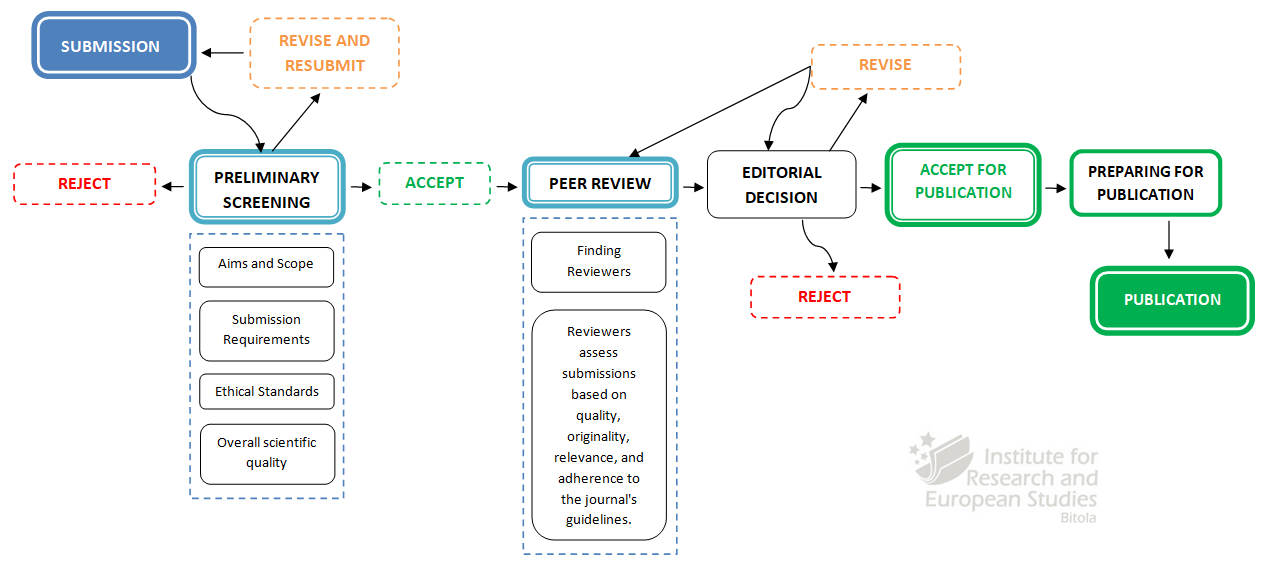
Preliminary Screening Process
Once an article is submitted, the editor conducts an initial evaluation to determine if it meets the following criteria:
- Relevance to the journal’s aims and scope.
- Compliance with the submission requirements (formatting, article structure, language, etc.).
- Compliance with the journal's ethical standards.
- Overall scientific quality.
Following the preliminary screening, one of the below decisions will be made:
- Rejection: If the article does not align with the journal’s focus or fails to meet the submission standards. Within six weeks of the initial submission, the corresponding author will receive an email confirming whether the article has been rejected. However, the journal reserves the right to take as much time as necessary, depending on the specific circumstances of each submission.
- Request for Revision: If the article has minor flaws or areas that need improvement, the editor will ask for necessary revisions. The author must address the requested changes and resubmit the article for re-evaluation.
- Peer Review: The article will be forwarded for peer review if it passes the preliminary screening.
Peer Review Process
All articles will be checked for plagiarism and misuse of generative AI tools before being sent to the reviewers. The journal uses Grammarly, a plagiarism and AI usage screening tool. Additionally, reviewers should alert the editors if they suspect any issues related to author misconduct, such as plagiarism or misuse of generative AI tools.
The peer review process typically takes up to two months and is unique for each submission.
At least two reviewers are assigned to each article, selected from an internal database, editorial board members, or through web searches to identify qualified and relevant experts. (Our journal is registered with ReviewerCredits).
Authors may suggest a minimum of two reviewers. It is important to note that we will approach the proposed reviewers only if our journal's appointed reviewers are unavailable or deemed unsuitable to review the submitted article. Otherwise, the suggested reviewers will not be considered for the review process.
The process follows a double-blind peer review model, ensuring that the identities of both authors and reviewers remain confidential.
At the conclusion of the review, the reviewers can make one of the following decisions:
- Accept the article as submitted.
- Return for minor revision and resubmission.
- Return for major revision and resubmission.
- Reject the article.
These recommendations are communicated anonymously to the authors and reviewed by the editor before a final decision is made on publication. If the editor suspects bias or ethical issues with a reviewer’s report, they may appoint a different or additional reviewer. This procedure may also be followed if the reviewers' reports differ significantly.
Authors must address all reviewer comments and recommendations within 20 days for minor revisions and within 45 days for major revisions. The revision process may involve multiple rounds until the editor is satisfied with the changes and can decide on acceptance.
If the manuscript has undergone significant changes, the work may also be rechecked for compliance with the publication's ethical guidelines.
When differences of opinion occur between reviewers, the editor-in-chief, in consultation with the associate editors, carefully considers all comments and arrives at a balanced decision. To assist in this process, reviewers should provide the editor-in-chief and associate editors with as much information as possible. A review that clearly outlines reasons for and against publication is, therefore, as valuable as, or even more valuable than, one that offers a direct recommendation.
If reviewers appear to disagree fundamentally, the editor-in-chief, in consultation with the associate editors, may choose to share all the reviews with each reviewer. This approach may elicit additional comments that could help the editor-in-chief and associate editors decide. The editor-in-chief and associate editors then assess the recommendations and comments of the reviewers, along with comments from the authors and any material that may not have been made available to those reviewers.
Once all procedures are complete, the editorial office will send a letter with one of the following decisions:
- The article is rejected, with clear reasons for rejection.
- The article is accepted for publication.
Criteria for Publication
Articles should represent a substantial advance in the particular field within the scope of the journal in terms of:
- Originality (in an empirical or theoretical sense).
- Importance to researchers in the field.
- Interest for readers and researchers outside the field.
Reasons for Rejection
- Insufficient scientific value or originality.
- The article falls outside the journal’s aims and scope.
- Failure to meet the publication’s formal standards or ethical standards.
- Evidence of citation manipulation.
- Incomplete or inadequate response to reviewer feedback and failure to implement necessary changes.
- Inclusion of emotional language that may mislead readers or is potentially defamatory.
- Disclosure of confidential information without proper authorization.
NOTE: All articles are evaluated based on the reviewers' recommendations.
Publication
After an article is accepted for publication, it is processed and formatted according to the journal's design guidelines. The corresponding author then receives an acceptance letter via email. On average, it takes 14 weeks from the submission deadline to publication. However, the journal reserves the right to extend this timeframe as needed, depending on the specific circumstances of each submission. Finally, the accepted article is published on the journal's website.
Expectations Post Review
(in compliance with the COPE Ethical Guidelines for Peer Reviewers)
Peer-reviewers should:
- Continue to keep details of the article and its review confidential.
- Respond promptly if contacted by a journal about matters related to their review of an article and provide the information required.
- Contact the journal if anything relevant comes to light after they have submitted their review that might affect their original feedback and recommendations.
- Read the reviews from the other reviewers, if these are provided by the journal, to improve their own understanding of the topic or the decision reached.
- Try to accommodate requests from journals to review revisions or resubmissions of articles they have reviewed.
Sharing Review Reports
After finishing the review, reviewers can share it on Publons. They can select this choice and record their review reports on Publons.
Acknowledgment to Reviewers
The journal is committed to recognizing and honoring the invaluable contributions of its reviewers. Since 2024, reviewers have been acknowledged annually at the end of each calendar year for their contributions to the issues published during that period. With their consent, reviewers’ names are listed in a dedicated section on the journal’s website as a public acknowledgment of their essential role in safeguarding the quality, integrity, and scholarly excellence of the publication process. Reviewers who choose to remain anonymous are equally valued, and their contributions are formally recognized and appreciated by the Editorial Board through internal records.
Despite their appearance in the dedicated section of the journal, reviewers will receive a Certificate for their review. To ensure that the certificate reflects the correct name and/or affiliation, reviewers should make sure their reviewer profile in OJS is up to date. Alternatively, they may contact us directly at the following email address [jlpe@iies.mk] to have the certificate issued with the correct name and affiliation.
Our journal is RC-registered; thus, we warmly recommend that reviewers create a profile on ReviewerCredits.

Editorial Office Materials Handling Policy
The journal editorial office does not store electronic materials not accepted for publication and does not deliver them back to the authors. The original reviews are stored in the editorial office's records for six months.
We appreciate the time and effort our reviewers put into evaluating articles for the Journal of Legal and Political Education.